
Condo rules · 8 min read
Condo flooring sound ratings: what IIC and STC tell you
Choose acoustic underlayment using the full test report and your building’s sound requirements.

Reviewed by Cedric Eckenrode, ownerUpdated November 2026
The short answer
IIC (Impact Insulation Class) rates footsteps and impact noise; STC (Sound Transmission Class) rates airborne sound such as speech and television. The 2021 International Building Code sets laboratory minimums of IIC 50 and STC 50, but your Naples association’s rule decides. Choose flooring and underlayment from the complete assembly’s test report, then compare options at ProFloors & Cabinets.
Before you submit, match the report's rating, test method and floor-ceiling construction to the installation you actually plan.
IIC and STC measure different sounds.
Impact Insulation Class, or IIC, rates how well an assembly limits sound from impacts on the floor. Sound Transmission Class, or STC, rates how well it limits airborne sound passing through. Higher numbers mean better insulation within each rating system. Read the two separately: they measure different sounds.
IIC: impact sound
STC: airborne sound
Question it answers
IIC: impact sound: How well does the assembly limit sound from standardized impacts on the floor?
STC: airborne sound: How well does the assembly limit airborne sound, such as speech and television?
Laboratory measurement
IIC: impact sound: ASTM E492: a standardized tapping machine on a floor-ceiling assembly.
STC: airborne sound: ASTM E90: airborne sound transmission loss through building partitions and elements.
Single-number classification
IIC: impact sound: ASTM E989 derives the IIC number from E492 data.
STC: airborne sound: ASTM E413 derives the STC number from E90 data.
Your association may require both. A high STC does not make up for a low IIC, or the reverse. When a brochure says acoustic, sound-reducing or soundproof, go straight to the test report. It states which sound was measured and how the tested floor-ceiling assembly was built.
Some buildings print both numbers. Beacon House in The Moorings asks for hard-floor underlayment rated at least STC 72 and IIC 68 in its October 2021 rules; others name an approved product and print no number. Ask your manager which kind of rule your building has.
Understand the IBC reference minimums.
The 2021 International Building Code, Section 1206, sets sound-insulation minimums for specified assemblies separating dwelling or sleeping units from each other or from public or service areas. Treat it as the model-code reference. For a flooring replacement in an existing Naples condo, the local building department confirms which adopted code applies.
Laboratory testing path
Field testing path
1206.2: airborne sound
Laboratory testing path: STC of at least 50 when tested to ASTM E90
Field testing path: Normalized Noise Isolation Class (NNIC) of at least 45 when field tested to ASTM E336
1206.3: structure-borne sound
Laboratory testing path: IIC of at least 50 when tested to ASTM E492
Field testing path: Normalized Impact Sound Rating (NISR) of at least 45 when field tested to ASTM E1007
Both code sections also allow an engineering analysis instead. Your association's written minimums and review process decide acceptance, alongside the applicable code. Meet both. A lower code figure does not override a higher association requirement, and an association’s approval does not replace the code requirement.
Distinguish lab ratings from field results.
In a laboratory test, the specimen is the main path sound can take between the test rooms. In a real building, connected walls and other construction carry sound around the floor. ASTM calls these routes flanking transmission. They are why a lab rating and a field measurement in an occupied building can differ.
Field tests of a real building use different ASTM methods and carry different rating names, such as NISR for impact sound and NNIC for airborne sound. Match the exact label on your report to the one your association names.
Keep lab and field results apart. The code sets different pass marks for each, and subtracting five points from a lab rating is not a field prediction. If the association writes shorthand such as field IIC or FIIC, ask its reviewer which test method and rating designation it accepts.
Match the underlayment to the assembly.
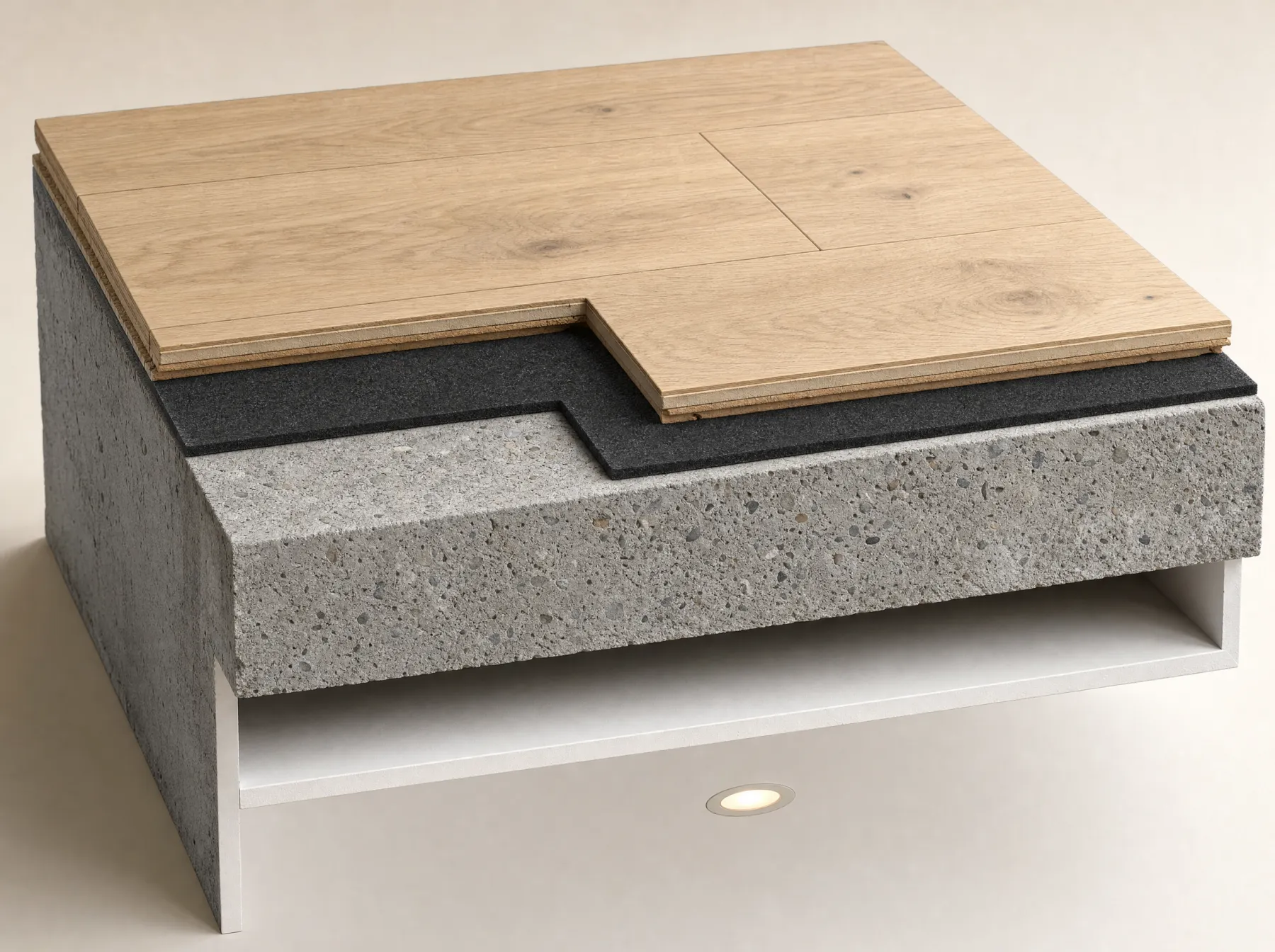
Read the floor covering, acoustic layer, structure and ceiling description as one system. Underlayment changes the tested assembly, and so does every other layer. A report tested with a suspended ceiling does not prove the same result in a unit without one. Point out any difference to the association's technical reviewer.
For a concrete condo floor, gather what is known about your unit's slab and ceiling. ASTM E492 names construction, mounting, stiffness and other assembly properties as factors in the measured sound. Judge each report against those details. A pad's name or thickness is no substitute, and individual product ratings cannot be added together.
A ΔIIC, or delta IIC, figure is the improvement a product adds under the test, not the complete assembly's IIC. Check which number your association wants.
The acoustic layer and installation method must also be permitted by the flooring and adhesive instructions; stacking layers does not make an acceptable system.
Read the report behind the brochure.
Identify the result
Note the lab or field location, report number, date, test method and exact rating designation. Check whether the number rates the full assembly or only an improvement.
Identify the construction
Read the flooring, underlayment, attachment method, structural floor and ceiling. Mark what matches your installation and flag what differs for the technical reviewer.
Identify the approval requirement
Get the association's minimum, the test documents it accepts and any technical review or field test it requires for your unit. Settle unclear rating terms with the manager before preparing the submission.
Resolve missing evidence
If a report leaves out assembly details, ask your designer and the association reviewer what documents or acoustic advice they need before the flooring is ordered.
Set realistic expectations for everyday sound.
A passing sound rating is not a promise of silence. ASTM E492's tapping machine does not reproduce a person's weight, and E989 notes limits with low-frequency sound and joist-floor noises such as creaks. Keep those limits in mind when you think about footsteps, dropped objects and furniture moving.
If existing noise is the reason for the renovation, describe the sound and where it is heard before choosing a surface. Ask the association manager whether an acoustic assessment makes sense. In a dispute, share the reports and known construction details; a product brochure cannot diagnose a sound path or prove a fix.
Compare documents in the showroom.
Bring the association's sound specification, any construction details and the full reports for your shortlist to the ProFloors showroom. Compare the floors with those documents beside the samples. Write down any open assembly questions for your designer or the association's technical reviewer, so the submission describes the floor you will actually install.
Sources (5)
- ICC: 2021 IBC Section 1206, Sound Transmission
Provides the model-code laboratory and field minimums and rating names in Sections 1206.2 and 1206.3, subject to applicable local requirements.
- ASTM E492-25: laboratory impact-sound transmission
Describes the tapping-machine laboratory method, assembly dependence, field-test distinction and limits in representing footsteps.
- ASTM E90-23: laboratory airborne-sound transmission
Describes airborne laboratory measurements, flanking transmission and the separate field-test method.
- ASTM E989-21: single-number impact-noise metrics
Distinguishes IIC, field impact metrics and delta IIC while explaining the rating’s sound-frequency limitations.
- ASTM E413-22: rating sound insulation
Identifies STC and field airborne-rating designations and explains why building results can differ from laboratory results.
Questions, answered.
Reviewed by Cedric Eckenrode, owner · Updated November 2026
The showroom
- 2033 Trade Center WayNorth Naples, FL 34109
- Mon–Fri 8am–5pmSat 10am–2pm
- What is the difference between IIC and STC for condo flooring?
- IIC rates impact-sound insulation; STC rates airborne-sound insulation. Laboratory IIC comes from tapping-machine measurements under ASTM E492, classified under E989. STC comes from ASTM E90 measurements, classified under E413. Both depend on the tested construction, so compare the complete report against your association's requirements, not the number alone.
- Is IIC 50 enough for a Naples condo floor?
- Not necessarily. IIC 50 meets the 2021 IBC laboratory minimum for covered floor-ceiling assemblies, but your association decides its own review, and the building may require a higher result or different documentation. Confirm the local code that applies, then submit evidence for the complete flooring and underlayment assembly you plan to install.
- Do Naples condos require sound insulation under new flooring?
- Check two places: the code and your association. The 2021 IBC, Section 1206, sets laboratory minimums of IIC 50 and STC 50 for covered assemblies between dwelling units. For a replacement floor in an existing Naples condo, the local building department confirms what applies, and your association's documents set its sound review and underlayment paperwork.
- Are laboratory IIC ratings the same as field sound ratings?
- No. Laboratory and field results follow different test methods and carry different rating designations. Field testing measures a real building, including sound traveling through other construction. Keep the report's exact label, such as NISR or NNIC, and check it against the test method and rating your association requires.
- One project managerFrom selection through installation
- No cost to come in and askBring your questions, photos or plans
- Trade buys here tooYour builder or designer can buy here
5.0· 46 Google reviewsBBB A+ AccreditedFamily-owned since 1998


Bring your questions to the showroom.
Condo flooring sound ratings: what IIC and STC tell you.